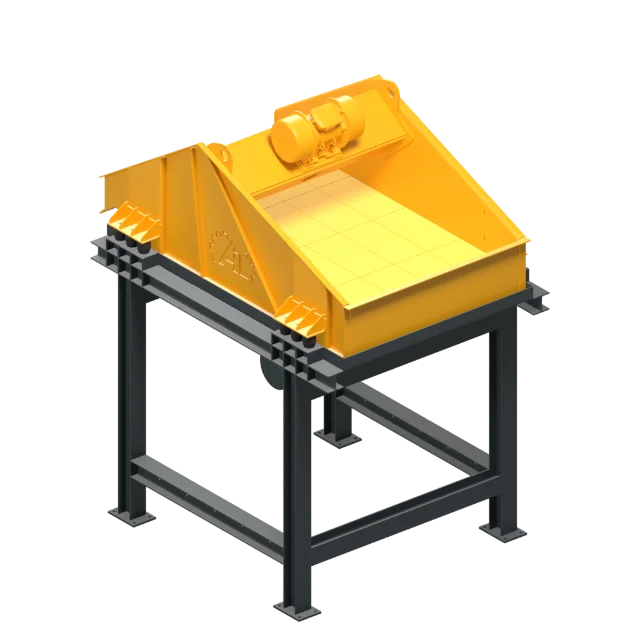

In a washing plant the sand does not leave the screen like the gravels, on a conveyor: it falls with the water, at the lowest point of the machine. To sell it, it has to be separated from the water without losing the finest fractions. That is the job of the bucket-wheel recovery unit, which recovers, drains and dewaters the sand in a single machine.
Where it fits
The recovery unit sits downstream of the screen. Under the decks, the lower collector gathers the undersize of the last mesh with the wash water; a siphon and a modular chute carry the mixture to the tank of the recovery unit. From there the sand leaves dewatered onto a conveyor or a stockpile, while the water leaves over the weir and goes on to the ponds or to water treatment.
To raise the discharge point, and so the stockpile or the conveyor that receives it, the LA-RSDT-50/600 can be installed on its stand.
01The machine
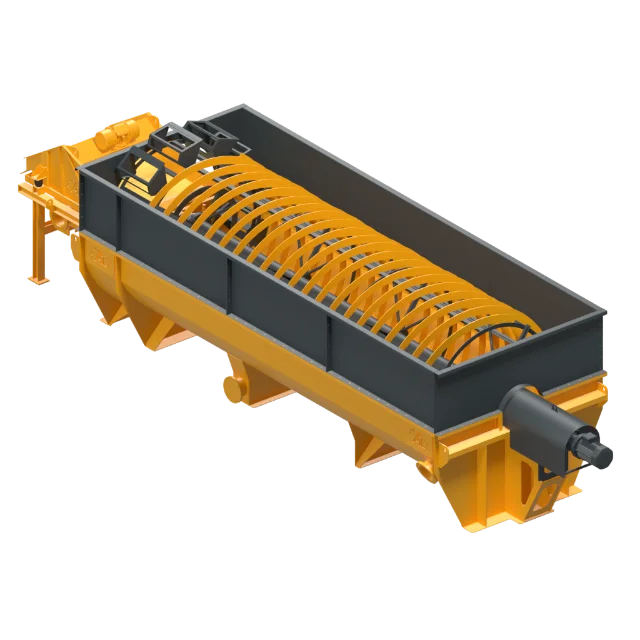
A tank, a shaft carrying the screw and the bucket wheel, a dewatering screen at the discharge.
02The tank
The mixture of water and sand enters the tank. The water slows down and the sand settles on the bottom.
03The screw
A screw carries the sand settled on the bottom towards the wheel.
04The bucket wheel
The wheel's draining buckets lift the sand out of the water: as they rise, the water drains away.
05The dewatering screen
At the top the buckets discharge onto the dewatering screen, which vibrates and removes more water before discharge.
06The weir
The water leaves over the overflow weir, at the end opposite the sand discharge, carrying away the finest particles.
07In operation
Water and sand go in, the sand leaves dewatered, the water leaves over the weir. The animation is illustrative.
The fine fractions the water would carry to the ponds become product again.
Three jobs in one machine
Recover
The sand arriving with the water settles on the bottom of the tank. The screw collects it and carries it towards the wheel, so the machine also takes back the finest fractions that have settled, instead of letting them go with the water.
Drain
The bucket wheel turns slowly, at adjustable speed. The buckets are draining buckets: they lift the sand out of the tank and let the water run off as they rise.
Dewater
At the top the buckets discharge onto the dewatering screen, whose vibration removes a further share of the water. The sand leaves with an even grading and low water content.
Dewatering or washing unit: two different machines
Alongside the LA-RSDT-50/600 there is the LA-RSLT-60/120, a bucket-wheel sand recovery and washing unit. The two machines look alike, but they do not do the same job and are not alternatives to each other.
Compare the models
Bucket-wheel sand recovery units
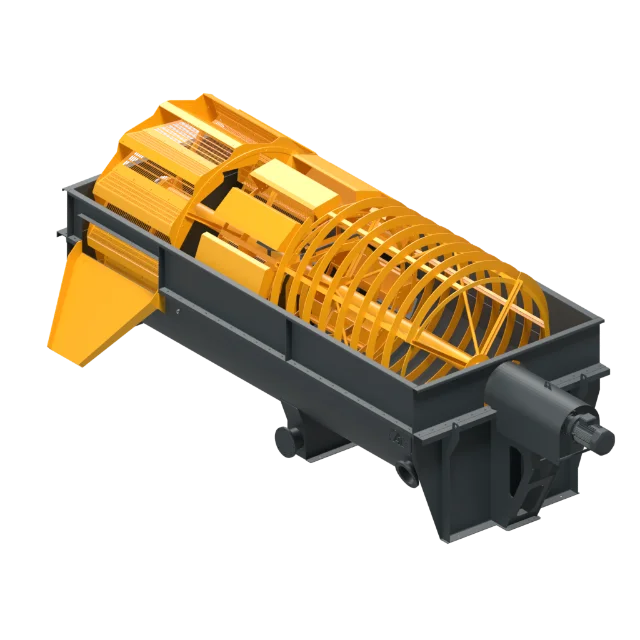
In the LA-RSLT the recovery wheel lifts the sand and tips it into a second tank of clean water; the discharge wheel picks it up again, drains it and discharges it. The water flows the opposite way to the sand and carries the finest particles over the weir. It is needed when the sand still arrives dirty; when it arrives already washed by the screen, the job is to recover and dewater it, and that is the LA-RSDT's job.
Different again is the LA-VA dewatering screen: a flat machine that removes water from a sand slurry with a linear vibration, with no tank and no wheel.
How to choose and how to read a quote
Sizing starts from what arrives from the screen: how much water, how much sand and with what grading. The engineering office checks that the chosen machine can handle these flows and the feed size; if the flow is larger, it assesses several units. Levels matter too: where the mixture comes from, at what height the sand must leave, where the overflow water goes.
The full path of the sand, from the screen to the stockpile, can be followed on the 3D model of the demonstration plant in the article Inside a screening and washing plant.
Frequently asked questions
How is fine sand recovered in a washing plant?
With a machine that receives the sand-laden water leaving the screen, lets the sand settle in a tank and takes it back with a wheel of draining buckets. The fine fractions, which would otherwise end up in the ponds with the water, become product.
What is the difference between a sand dewatering unit and a sand washing unit?
The LA-RSDT-50/600 dewatering unit recovers, drains and dewaters already washed sand with a dewatering screen. The LA-RSLT-60/120 washing unit has two wheels and two washing stages with counter-flowing water: it is for heavily contaminated sand.
How much material does the LA-RSDT-50/600 handle?
The published maximum feed rate is 60 m³/h, with a 0/6 mm feed size. Full data are in the data sheet, which can be requested from the product page.
What does the dewatering screen on the recovery unit do?
It removes a further share of the water after draining on the buckets: the sand leaves with an even grading and low water content, ready for the conveyor or the stockpile.
Where does the recovery unit go in a plant?
Downstream of the screen: it receives the sand and wash water from the lower collector through a siphon and a chute. It can be raised on a stand to lift the discharge point.
Written by the Abronzino engineering office. The figures quoted are those published on this website; full data are in the data sheets, available on request from the product pages. The 3D animations are illustrative.