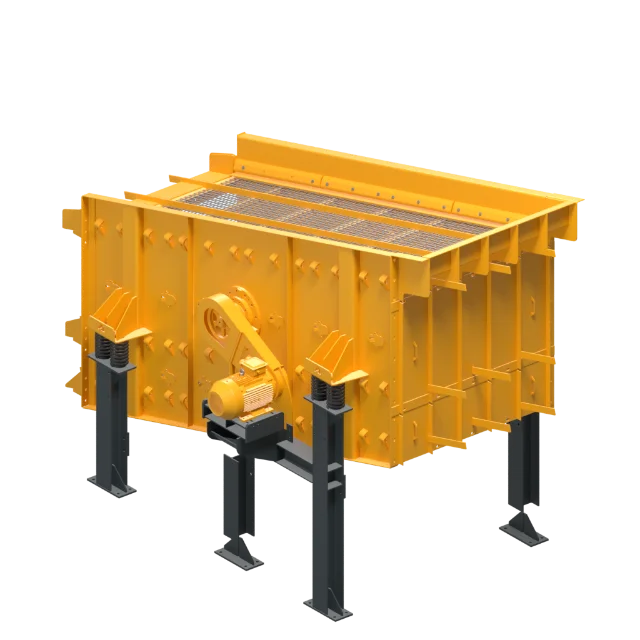

The vibrating screen is the machine that decides how many products leave the plant and how clean they are. It works on a few simple principles: an inclined deck, a mesh with apertures of known size, and a motion that makes the material bounce on the mesh thousands of times a minute. Everything else, meaning output, sharpness of separation and service life, depends on how those principles are put together.
How it works: slope, vibration, gravity
On Abronzino inclined vibrating screens the decks slope at 15°. The body rests on steel springs and is set vibrating by a mechanical vibrator unit: a shaft carrying eccentric masses, driven by the motor. At each turn of the shaft the body describes a small circular motion, many times a second.
Thrown up and forward at each oscillation, the material makes a series of small hops along the deck. During the hops the bed sorts itself by size: the smaller grains move down towards the mesh and pass through the apertures, the larger ones stay on top and travel to the discharge edge. The amplitude of the motion is adjustable, so the same machine adapts to different materials and products.
n meshes give n + 1 fractions: each deck retains its own.
Decks, meshes and fractions
Each deck carries a mesh and retains the material coarser than its aperture. n meshes give n + 1 fractions: the oversize of each deck, plus the undersize of the last one. A three-deck screen gives four products, a four-deck screen gives five. Meshes are chosen by aperture and material; they are tensioned from the sides on the deck frames and replaced when worn or when the products change.
In wet screening the spray bars wash the material as it moves along the decks: fines and impurities fall with the water, and the undersize of the last deck, the sand, leaves with the wash water towards the sand recovery unit.
01The screen on its structure
The LA-VVP-6183-OR09, the largest of the heavy-duty series, has three screening decks. Here it sits on the LA-IV-618 support structure, with collectors and spray system.
02Feeding
The aggregate, up to 120 mm, enters from the feed box at the upper end and spreads across the full width of the first deck.
03The vibrator unit
On the side, the eccentric-mass vibrator unit, driven by the 30 kW motor, sets the whole body vibrating.
04The springs
The body rests on sixteen steel springs: it vibrates, not the structure that supports it.
05The outlets
The oversize of each deck leaves from the lower edge; the front collector sends the three gravels to the chutes, each towards its own conveyor.
06In operation
The material hops along the three decks and splits into four fractions. The animation is illustrative: it shows the path, not the real speed.
Heavy-duty, scalping and dewatering screens
Machines with different jobs share the name vibrating screen. In the catalogue, models of the same family can be compared side by side, with the figures from the product pages.
Compare the models
Inclined vibrating screens: scalpers and heavy-duty series
Compare the models
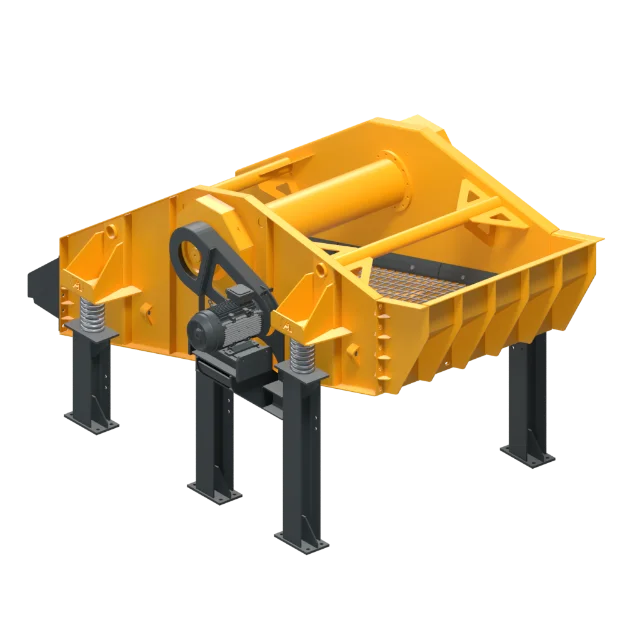
Dewatering vibrating screens
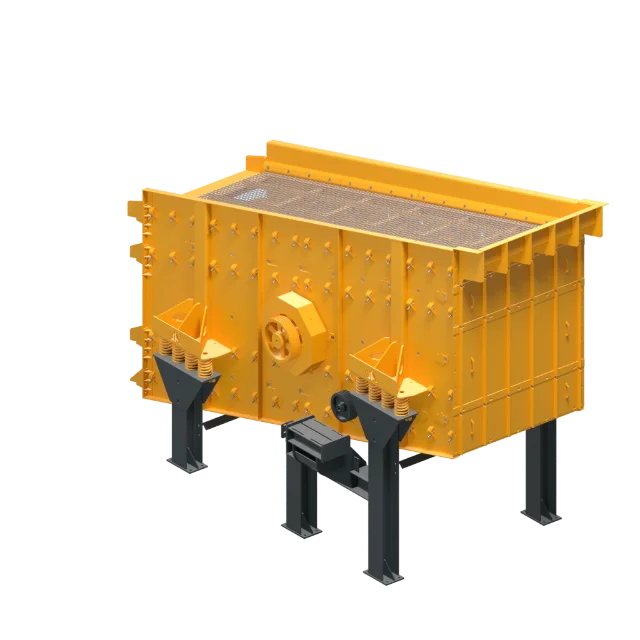
The heavy-duty series
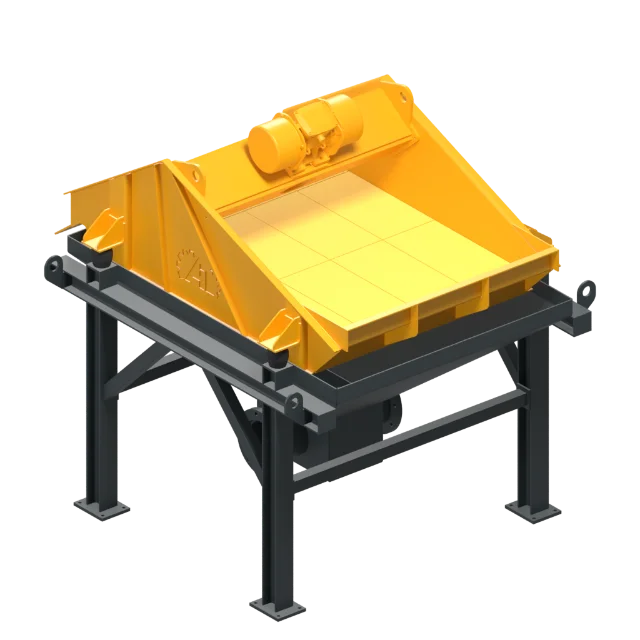
The LA-VVP screens work in open execution on alluvial and quarry aggregates, with three or four decks. The force of the vibrator unit is adjustable, so the same machine adapts to different materials and products.
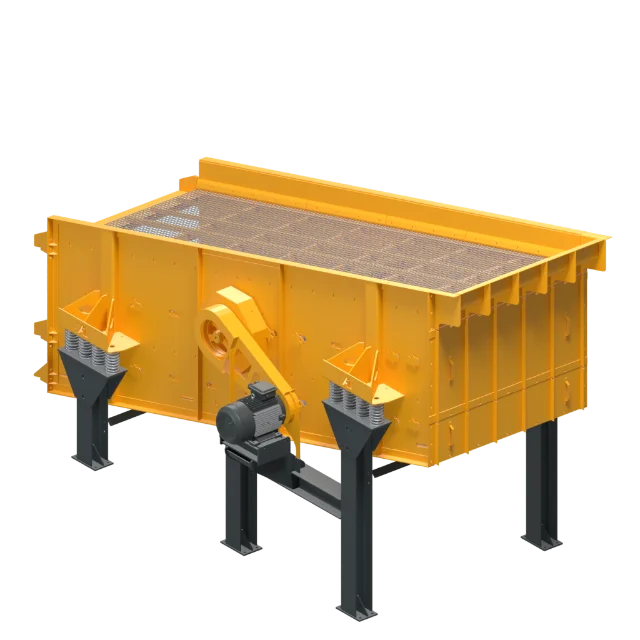
Scalping screens
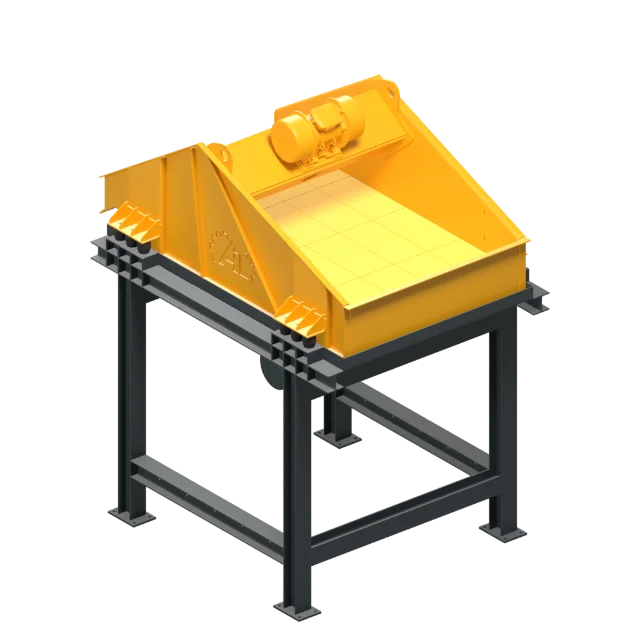
The LA-VVS have a single mesh and two fractions. They remove the coarsest size before the actual screening, so the machines downstream receive material within the limits they are designed for.
Dewatering screens
The LA-VA work flat, not inclined, and use a different motion: two counter-rotating vibrating motors give a linear vibration directed towards the discharge. They do not sort by size but remove water: the sand travels over the dewatering panels and the water passes underneath.
What determines the output
The capacity of a screen is not a fixed number of the machine. For the same screen it changes with:
- the grading of the feed: the more material has to pass through a deck, the more area it needs;
- the mesh apertures and the mesh material, which changes the open area;
- the feed: a steady flow spread across the full width yields more than one that arrives in surges;
- washing, which helps the fines through;
- the moisture and nature of the material, which can blind the smallest apertures.
When a screen is overloaded, the first sign is in the products: material that should have passed remains in the oversize of a deck. That is why a stated capacity must always be read together with the meshes and the material it was calculated for.
To compare two screens when buying, the article Two quotes for the same screen lists the items to check, with a checklist to fill in.
Frequently asked questions
How does a vibrating screen work?
The screen body rests on springs and is set vibrating by a vibrator unit: a shaft with eccentric masses driven by a motor. At each turn the material makes a small hop along the inclined deck: grains smaller than the mesh aperture pass, larger ones travel to the discharge edge.
How many fractions does a three-deck screen give?
Four: the oversize of each of the three decks plus the undersize of the last one, which in wet screening is the sand.
What does the capacity of a vibrating screen depend on?
On the deck area, the mesh apertures and material, the grading of the feed, how the material arrives and washing. That is why a stated capacity must be read together with the meshes and material it was calculated for.
What is a dewatering screen?
A screen that works flat with a linear vibration from two counter-rotating vibrating motors: it does not sort by size but removes water from the sand, which travels over draining panels.
What is a scalping screen for?
It removes the coarsest size before the actual screening, with a single mesh and two fractions, so the machines downstream receive material within their limits.
Written by the Abronzino engineering office. The figures quoted are those published on this website; full data are in the data sheets, available on request from the product pages. The 3D animations are illustrative.