
In the demonstration screening and washing plant, six of the fourteen machines and structures are conveyors. That is normal: conveyors connect everything else, lift the material and spread it to the stockpiles. They decide the layout, the heights and how much space is needed. Choosing a conveyor well means choosing three things: the structure, the belt width and the geometry it is installed with.
Truss or channel frame
In-house conveyors share the same working parts (rubber belt, lagged drive pulley, take-up, belt scrapers) and differ in the structure that carries them. Across the range, belt widths go from 500 to 1,200 mm, with capacities from 20 to 450 m³/h.
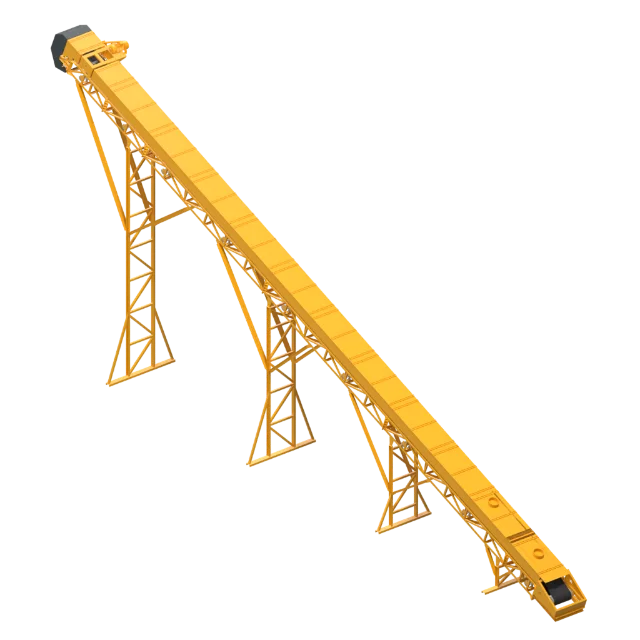
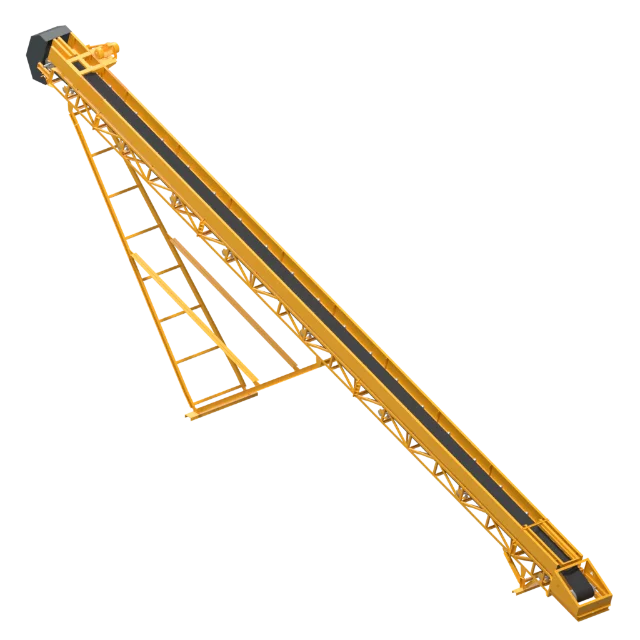
A truss structure in angle steel, made of bolted sections. It is stiff and light: it covers very long free spans with few trestles. It is the choice for long conveyors climbing to the screen or feeding high stockpiles.
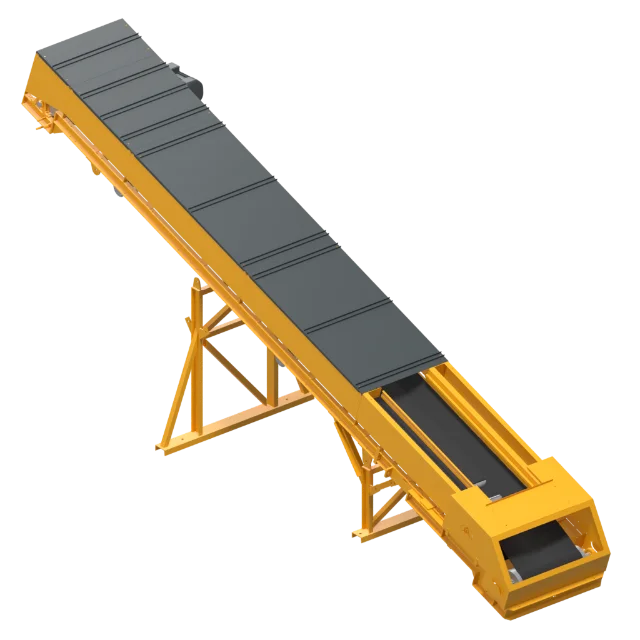
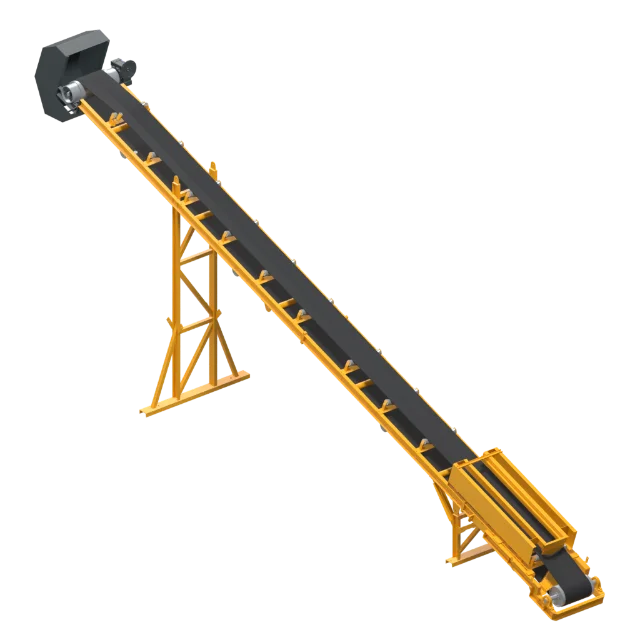
A frame in UPN steel channel, more compact. It is designed for installation in tight spaces and for short conveyors, under machines or between one machine and the next.
Compare the models
Belt conveyors
Conveyors are the most numerous machines in a plant, and the ones that hold it together.
Width, capacity and lump size
The belt width fixes the maximum capacity and the lump size the conveyor can carry. The values below are those of the data sheets, with the conveyor inclined at 18°, the reference slope.
Belt width
Models: LA-TNT-650 · LA-TNU-650.
Two remarks help to read these figures. The stated capacity applies with the conveyor at 18°: the steeper the conveyor, the more the material tends to roll back and the lower the useful capacity. And the maximum lump size refers to the largest blocks the conveyor accepts: if they arrive often, it is better to go up a width.
Slope and discharge height
The height at which a conveyor discharges depends on its length and on the slope it is installed at, and it decides how much material the stockpile under the head can hold. Long truss conveyors lift the material high for large stockpiles; shorter channel-frame conveyors connect machines to each other. The length and slope of each conveyor are set on the plant design.
01The installed conveyor
An LA-TNT-650 as installed in a plant: the truss climbs to the discharge point resting on a few trestles.
02The tail
The material falls onto the belt in the loading zone; the take-up keeps the belt tensioned.
03The truss
The bolted truss sections carry themselves over long spans: a few trestles are enough.
04The drive head
At the head the rubber-lagged drive pulley pulls the belt; the scraper cleans it after discharge.
05In operation
The material climbs along the truss and is discharged to stockpile. The animation is illustrative.
The parts that count over time
Two conveyors of the same width can last very differently. The items to look at in a quote are the ones that wear or protect:
- the belt: number of plies and cover thickness;
- the idlers: diameter and layout, troughed on the carrying side;
- the belt scrapers, front and rear, which prevent material building up on the pulleys and under the conveyor;
- the guards on the moving parts and, on long conveyors, walkways and stairs for inspection;
- the trestles: number, height and footing.
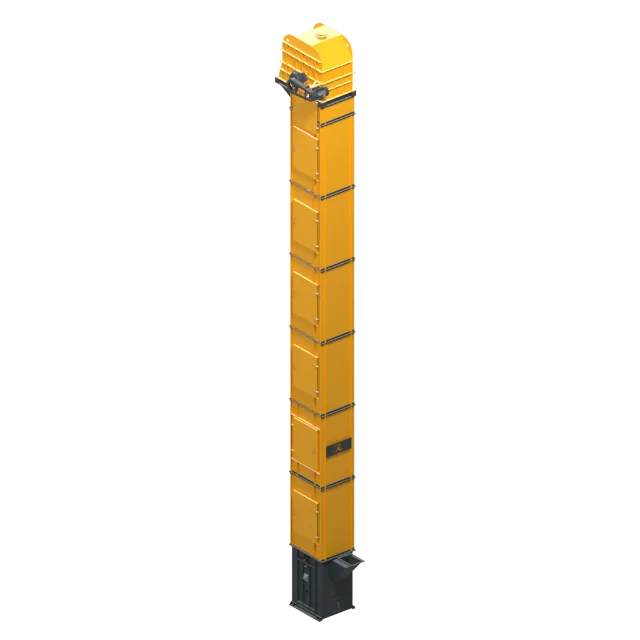
When there is no room to climb on a slope, material up to 10 mm, dry or wet, is lifted vertically with a high-speed belt bucket elevator: the LA-ETNV-350 carries up to 100 m³/h with a modular casing that extends to the required height.
Frequently asked questions
How is the width of a belt conveyor chosen?
According to the capacity and the maximum lump size of the material. On in-house conveyors at 18° slope, a 500 mm belt carries up to 70 m³/h with lumps up to 150 mm, a 1000 mm belt up to 280 m³/h with lumps up to 300 mm.
What is the difference between a truss conveyor and a channel-frame conveyor?
A truss conveyor has a lattice structure in bolted angle steel, stiff and light, that spans very long distances with few trestles. A UPN channel-frame conveyor is more compact, suited to tight spaces and short runs.
How steep can an aggregate belt conveyor be?
The reference slope of Abronzino conveyors is 18°: the published capacities apply at this slope. A steeper conveyor carries less, because the material tends to roll back.
Which parts of a conveyor should be checked in a quote?
Belt, idlers, belt scrapers, take-up, guards, walkways and trestles: the parts that wear or protect, which decide how long the conveyor lasts.
When is a bucket elevator used instead of a conveyor?
When there is no room to climb on a slope and the material is fine: LA-ETNV high-speed belt bucket elevators lift material up to 10 mm vertically.
Written by the Abronzino engineering office. The figures quoted are those published on this website; full data are in the data sheets, available on request from the product pages. The 3D animations are illustrative.